Human-AI Systems /
How Is AI Shaping Human-Computer Interaction?
The integration of artificial intelligence into interactive technologies represents a seismic shift in human-computer collaboration. Pioneering thinkers like Brenda Laurel recognized this disruptive potential decades ago, contemplating “computers as theatre” where machine cognition simulates human conversation. By the 2010s, exponential improvements in machine learning drove prolific adoption of AI assistants, social bots and related technologies. However, researchers like Sherry Turkle warned these autonomous systems risk deceiving people if not designed transparently. Today, AI plays an increasingly prominent role in interaction design - powering predictive recommendations, natural language processing and ambient personalization among other capabilities. This prompts novel questions around aligning intelligent interfaces with human values and ethics. HCI practitioners strive to develop symbiotic partnerships where AI enhances rather than replaces human strengths. The ideal integration of emerging machine cognition with individual human judgment remains an ongoing exploration. But pioneering research provides guiding principles - from preserving user control to allowing override of automated decisions. With thoughtful co-design, AI and HCI can evolve in complementary ways where intelligent systems empower people and respond insightfully to meet diverse needs.
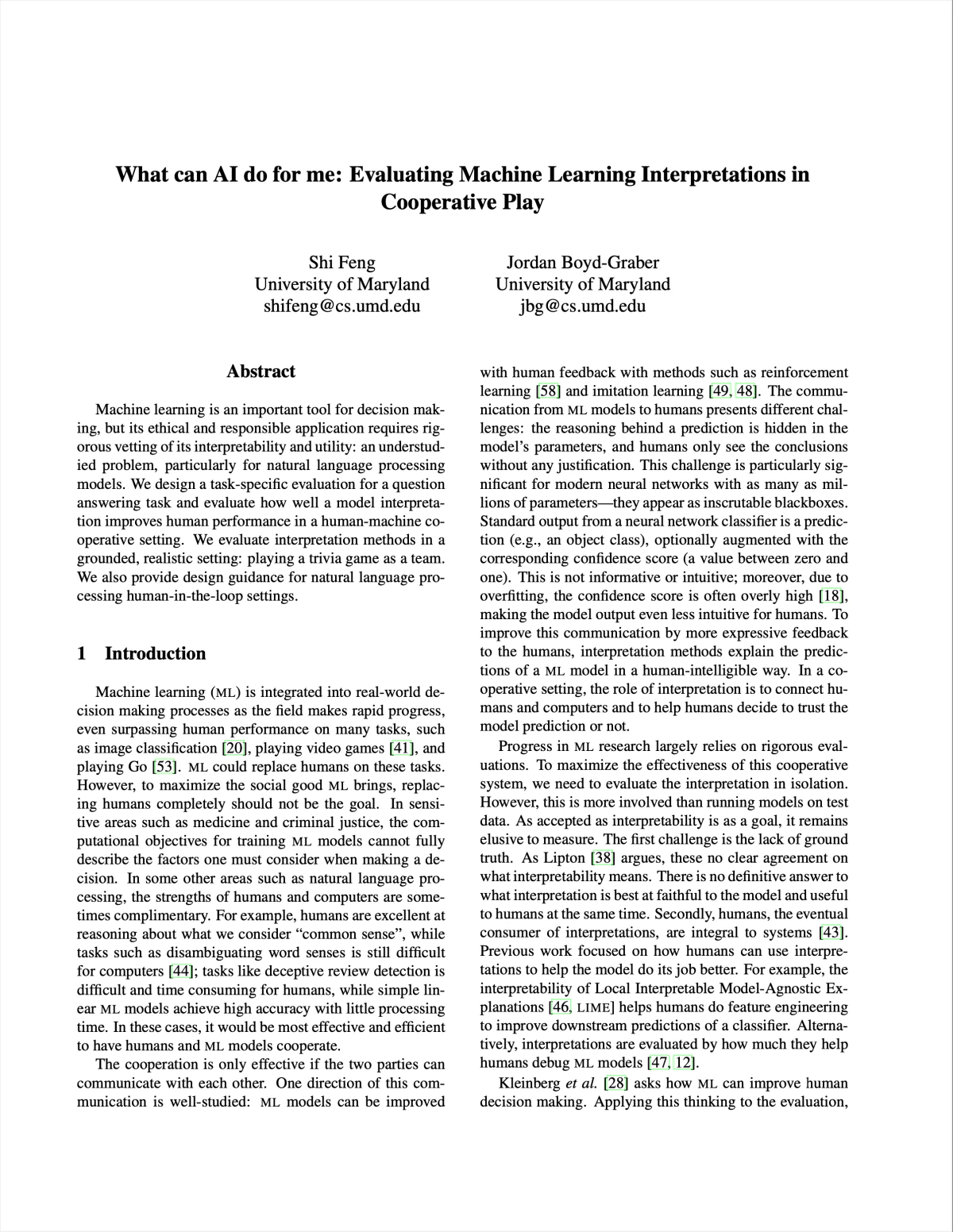
What can AI do for me: Evaluating Machine Learning Interpretations in Cooperative Play
Shi Feng, Jordan Boyd-Graber · 01/10/2018
The paper explores how machine-learned models, particularly those related to cooperative games, can be interpreted and used effectively in the field of HCI. The document is a significant contribution that centers on machine learning and the interpretability of AI.
- AI in cooperative play: The authors demonstrate how varied AI representations impact cooperative play. They use strategically complex games to exemplify AI-human interaction nuances.
- Real-time machine learning interpretations: The paper reveals how real-time machine learning interpretations can significantly enhance user experience and performance in a cooperative environment.
- Player strategy: The authors establish that a better understanding of player strategy, aided by machine interpretations, can boost cooperative outcomes and overall gameplay.
- Algorithmic transparency: The authors stress the importance of algorithmic transparency and how this can enhance user trust and engagement with AI in cooperative play.
Impact and Limitations: This research provides valuable insights into the integration between AI and HCI, especially in real-time cooperative environments. Examples from this study can be utilized in developing more intuitive AI systems. However, the research lacked diversity in the games used, which may limit its applicability. More research is needed to generalize these findings.
Read more
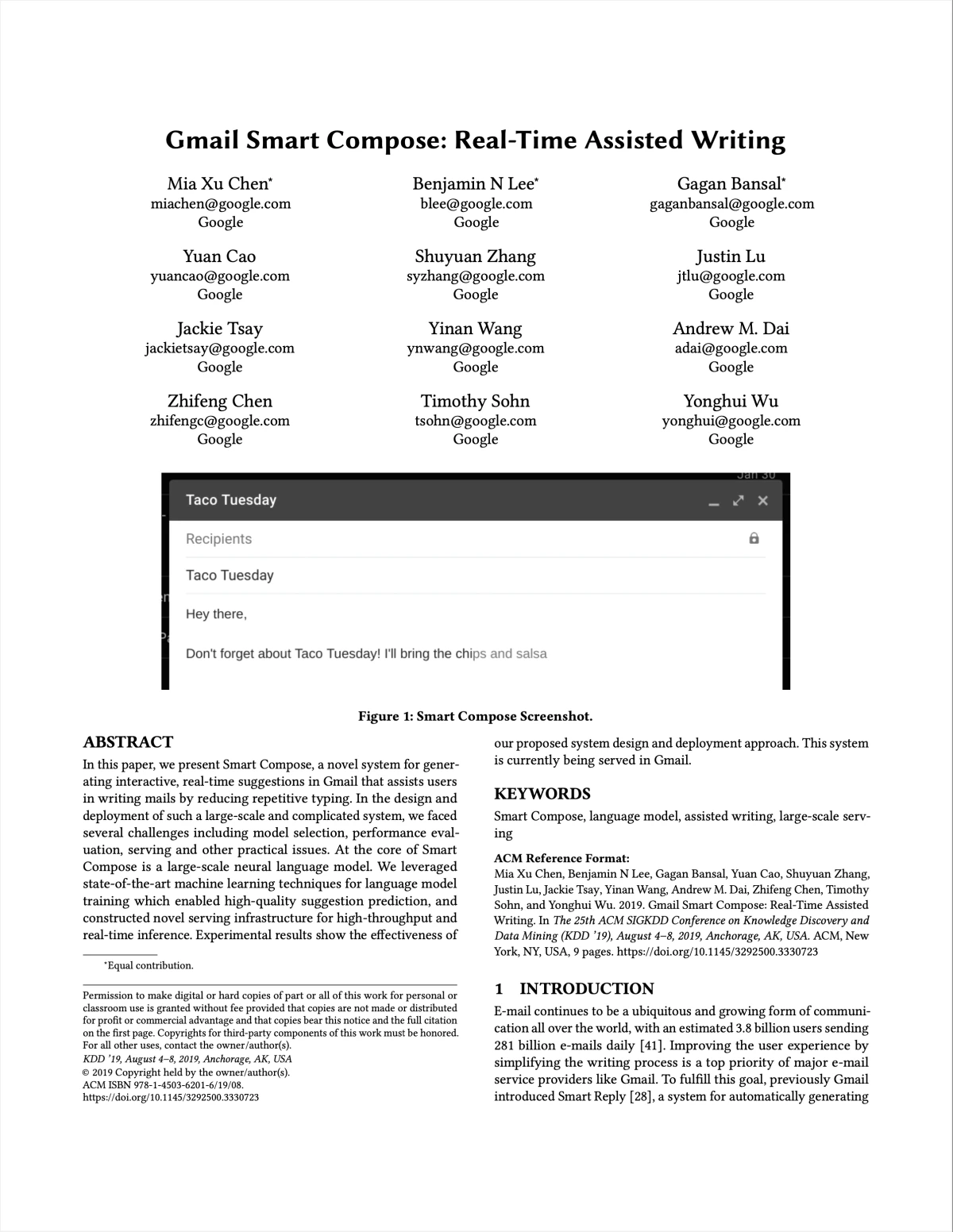
Gmail Smart Compose: Real-Time Assisted Writing
M. Chen, Benjamin Lee, G. Bansal, Yuan Cao, Shuyuan Zhang, Justin Lu, Jackie Tsay, Yinan Wang, Andrew M. Dai, Z. Chen, Timothy Sohn, Yonghui Wu · 01/05/2019
The paper "Gmail Smart Compose: Real-Time Assisted Writing" presents the development of Smart Compose, a revolutionary plug-in for realtime writing assistance in Gmail. The tool dynamically suggests sentence completions while users are composing emails.
- Real-time Prediction: Smart Compose suggests next phrases while users are typing, improving email productivity. It's a significant leap in intuitive predictive technology that transforms HCI.
- ML-driven Language Model: The tool relies on machine learning and language modeling for generating accurate predictions, a pivotal advancement for user interface improvements in HCI.
- Privacy Concern: While enhancing communication, Smart Compose might raise potential privacy issues due to continuous data analysis. It underscores the critical need for robust privacy management in next-generation HCI systems.
- Personalized Suggestions: Smart Compose offers personalized suggestions, refining the cognitive load on users, thus revolutionizing email interactions for a more efficient HCI.
Impact and Limitations: The paper sets a new benchmark for functionalities real-time writing aids in HCI can offer, enhancing productivity and communication efficiency. However, issues related to privacy and data protection may present challenges. Future research should prioritize addressing these aspects while capitalizing on the advancements introduced by Smart Compose.
Read more
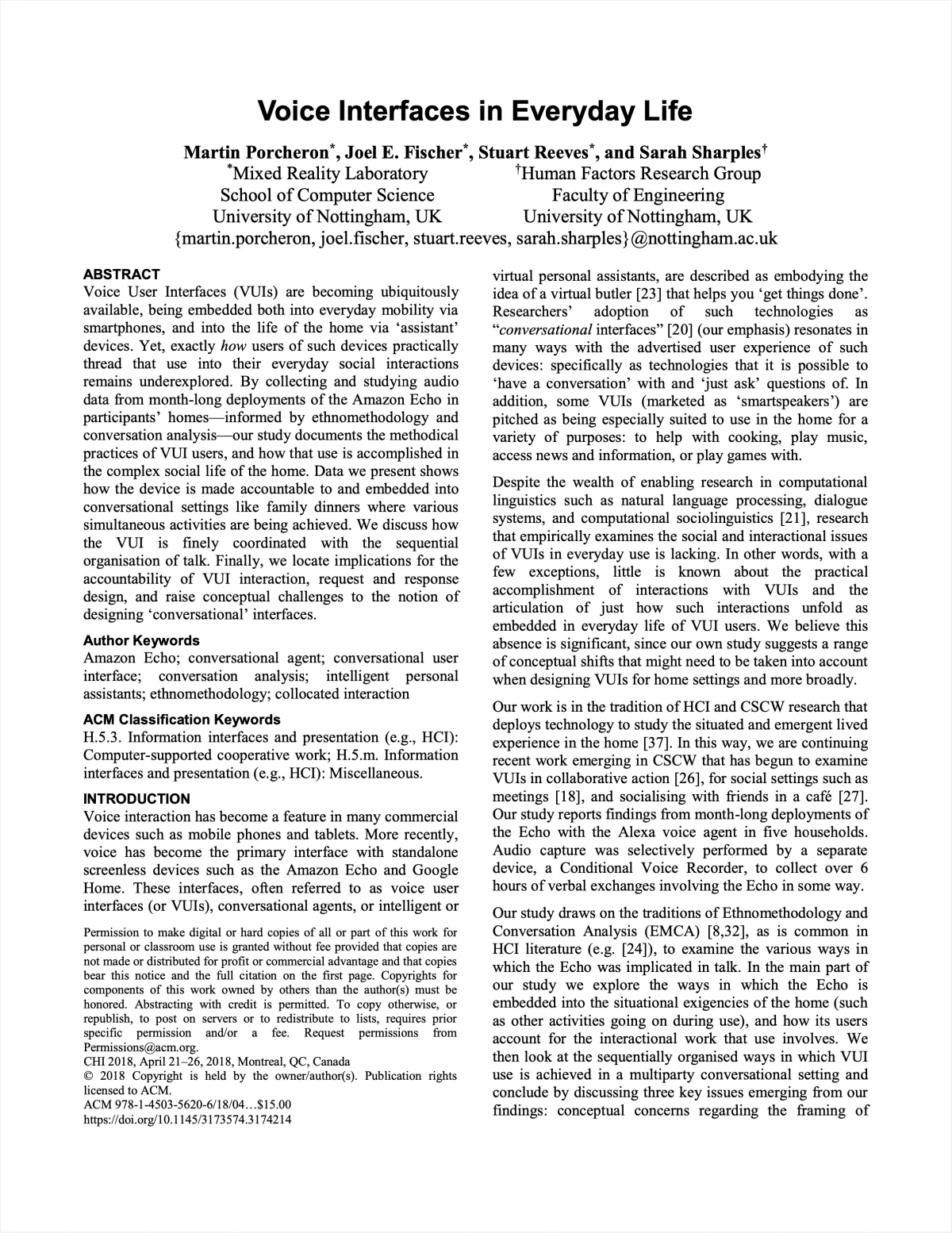
Voice Interfaces in Everyday Life
Martin Porcheron, Joel E. Fischer, Stuart Reeves, Sarah Sharples · 01/04/2018
Voice Interfaces in Everyday Life is a seminal study investigating how voice user interfaces (VUIs) are used and integrated into daily routines. The research has enriched Human-Computer Interaction (HCI) by providing realistic insight on voice-controlled technology.
- Ubiquitous Usage of VUIs: The authors found that VUIs usage isn't limited to personal spaces, but extends into social environments, contributing to a shift in public acceptance and attitudes towards VUIs.
- Dialogic Interactions: VUIs often prompt dialogic interactions between users and devices, simulating verbal exchanges between humans. This interactive style reshapes man-machine interactions, making them more conversational.
- VUIs as social entities: The study also revealed that VUIs are often treated as social entities, demonstrating our readiness to anthropomorphize technology.
- Interaction challenges: However, the research cited issues of intelligibility, and voice recognition as potential hurdles inhibiting efficient VUI-user interaction.
Impact and Limitations: The research underscores the growing normalization of VUIs and their profound impact on social and individual user interactions. It elicits a designed response to these challenges, aiming for more intuitive and conversational interfaces. Still, the study's reliance on observational methodologies may not fully capture nuanced user experiences or attitudes towards VUIs. Future research could explore more granular user perspectives through mixed-methods approaches.
Read more
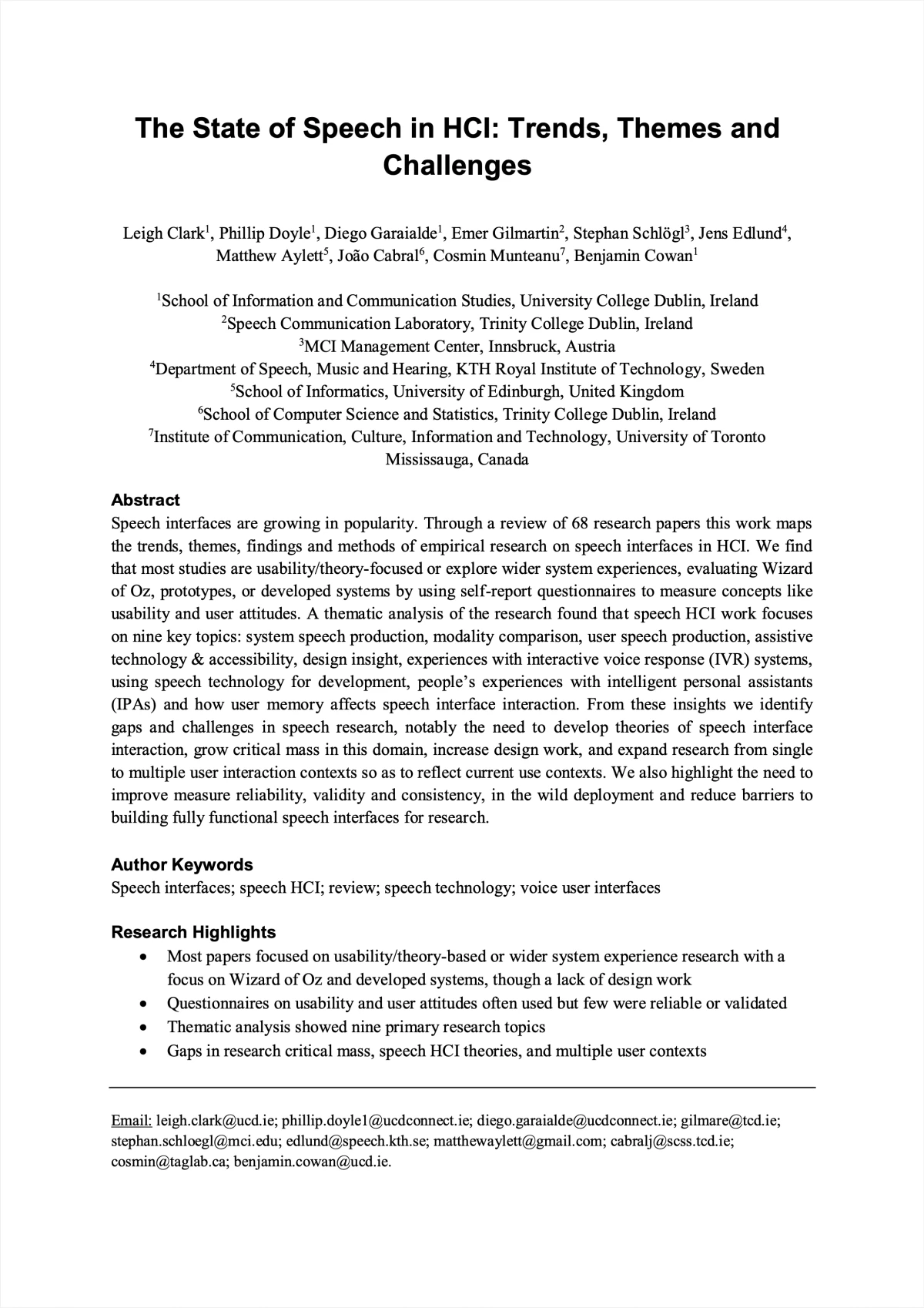
The State of Speech in HCI: Trends, Themes and Challenges
Leigh Clark, Phillip Doyle, Diego Garaialde, Emer Gilmartin, Stephan Schlögl, Jens Edlund, Matthew Aylett, João Cabral, Cosmin Munteanu, Benjamin Cowan · 01/10/2018
This paper presents an analysis of the current state of speech-based Human-Computer Interaction (HCI) by examining trends, challenges and emerging themes in the field.
- Speech Recognition Technology: The paper highlights the advancements in speech recognition technology as one of the key influences shaping HCI. This technology enables natural voice-based interaction with devices, enhancing their accessibility and user engagement.
- User Adaptiveness: The authors also touch on the need for speech-based systems to adapt to the specifics of individual users, including accent, sociolinguistic background, and speech impairments. This calls for a more inclusive design approach.
- Complex Interactions: Emphasis is placed on the need for handling more complex interactions beyond simple 'command and control' style interactions. Systems need to understand context, emotion, and conversational nuances to respond appropriately.
- Ethics and Privacy: Significant concerns are raised about the ethical and privacy implications of always-on voice interfaces. These challenges are growing with the increasing ubiquity of such devices in our environments.
Impact and Limitations: The paper underscores the transformative potential of speech-based interaction, while urging HCI researchers to seek innovative solutions for imminent privacy and ethical challenges. Future HCI studies should address the identified limitations, such as lack of adaptiveness to individual user characteristics and struggles with complex interactions.
Read more
Closing the Loop: User-Centered Design and Evaluation of a Human-in-the-Loop Topic Modeling System
Alison Smith-Renner, Varun Kumar, Jordan L. Boyd-Graber, Kevin Seppi, Leah Findlater · 01/03/2018
This paper presents a transformative iterative approach to HCI by integrating the user into the design and evaluation process of a topic modelling system.
- User-Centered Design: The paper advocates for integrating the end-user into the development process, prioritizing their needs and experiences to build a more effective system.
- Human-in-the-Loop Machine Learning: A new approach to ML that allows for human feedback during the training process, helping machines to model more complex criteria.
- Iterative Design: Multiple iterations and user feedback refine the system at different stages, enhancing the overall utility and user experience.
- Evaluation of Topic Modeling Systems: The authors set a new precedent in evaluating ML tools, incorporating user feedback for accurate and user-friendly interpretations.
Impact and Limitations: The paper pushes the boundaries of traditional HCI design by emphasizing user participation. This can influence the development of machine learning tools to be more user-centric. However, this approach can be time-consuming and could potentially be biased by user's subjective evaluations. Further research needs to ensure that enough user diversity is incorporated into the loop to mitigate this bias.
Read more
What Makes a Good Conversation? Challenges in Designing Truly Conversational Agents
L. Clark, Nadia Pantidi, Orla Cooney, Philip R. Doyle, Diego Garaialde, Justin Edwards, Brendan Spillane, Christine Murad, Cosmin Munteanu, V. Wade, Benjamin R. Cowan · 01/01/2019
This 2019 HCI research paper dissects the important aspects of creating conversational agents that can mimic human interaction at optimal levels. It embraces an incredible, data-driven approach in examining conversational design in HCI.
- Conversational Design: A complex process involving numerous factors. Creating effective, human-like interactions requires a sound strategy and targeted user research.
- Conversational Agents: Designing them involves meticulous balancing of diverse and complex factors. Technological capability, social context, and agent personality should be taken into account.
- Data-Driven Approach: The study involved an examination of over 600 real-life human conversations to understand messaging patterns and dialog structures better.
- Context: The concept goes beyond the physical setting. It relates to the user’s personal, social, and cultural context, and the device context.
Impact and Limitations: The results shed light on the importance of understanding human conversations and reflecting them in conversational agents. The paper, however, acknowledges the limitations of current technologies in capturing nuanced aspects of communication, emphasizing the need for continued research and development.
Read more
May AI? Design Ideation with Cooperative Contextual Bandits
Janin Koch, Andrés Lucero, Lena Hegemann, Antti Oulasvirta · 01/05/2019
The 2019 CHI paper "May AI? Design Ideation with Cooperative Contextual Bandits" explores the integration of AI algorithms, specifically Cooperative Contextual Bandits, into the design ideation process. The paper bridges machine learning and HCI, suggesting that AI can function as a collaborative tool for human designers, rather than a replacement.
- Cooperative Contextual Bandits: The paper utilizes this specific machine learning algorithm to enhance human creativity by suggesting novel design elements based on context. This represents an advanced application of machine learning to HCI.
- Human-AI Collaboration: The work focuses on a cooperative model where both human intuition and AI computation are leveraged, redefining the designer-tool relationship and offering a nuanced understanding for practitioners.
- Ideation Amplification: Through the use of AI, designers can quickly generate a broader range of ideas, emphasizing the need for tools that augment human capabilities rather than replace them.
- User Testing: The paper incorporates real-world user testing, providing empirical evidence to support its claims and methods.
Impact and Limitations: This paper has strong implications for the future of HCI and design practices, suggesting that AI can play a meaningful role in creative processes. However, it also raises ethical and practical questions, such as how to balance human and machine input and the risk of algorithmic bias.
Read more
Help, Anna! Visual Navigation with Natural Multimodal Assistance via Retrospective Curiosity-Encouraging Imitation Learning
Khanh Nguyen, Hal Daume · 01/09/2019
This paper's central theme is using natural multimodal assistance for visual navigation via retrospective curiosity-encouraging imitation learning. It provides a novel perspective on HCI, particularly in the domain of human-robot interaction.
- Retrospective Curiosity-Encouraging Imitation Learning (RCEIL): The paper describes RCEIL as an approach to incorporate flexible human interventions during robot learning. This allows for better performance by encouraging exploration of states overlooked during initial learning.
- Natural Multimodal Assistance: Nguyen and Daumé propose the integration of natural multimodal assistance (spoken directions and teleoperation signals) in visual navigation tasks, creating more intuitive human-robot interaction.
- Imitation Learning from Observation (LfO): The study applies LfO to learn policies from demonstrations, promoting an inclusive approach in HCI, even with non-expert users.
- 'Help, Anna!' Dataset: A key contribution is the introduction of the 'Help, Anna!' dataset, comprised of real-world human-assisted visual navigation scenarios, providing a rich resource to the HCI and robotics communities.
Impact and Limitations: The integration of natural multimodal assistance and RCEIL may revolutionize human-robot interaction, making it more accessible and intuitive. The 'Help, Anna!' dataset provides a valuable resource for future research. However, the study's reliance on external human intervention limits the autonomy of the learning agent. Future research may focus on reducing this dependency to achieve fully autonomous learning.
Read more
Predictive Text Encourages Predictable Writing
Kenneth C. Arnold, K. Chauncey, Krzysztof Z Gajos · 01/03/2020
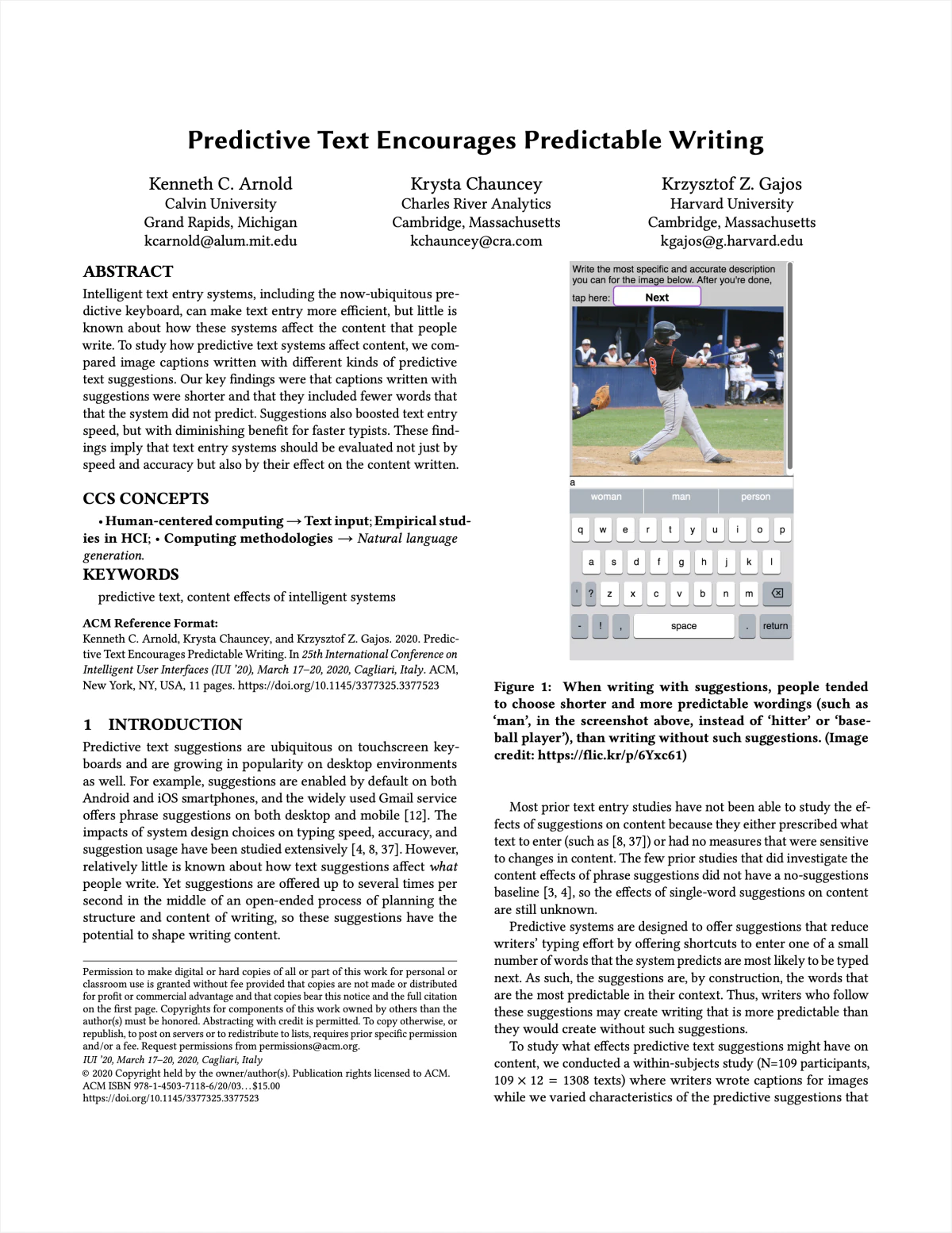
This paper delves into the unexplored territory of how predictive text can influence the originality of content. It contributes a fresh perspective to the HCI community by elucidating the affect of predictive text on human writing behavior.
- Predictive Text Impact: The authors argue that predictive text steers writers towards more predictable and mainstream phrases, potentially reducing originality.
- Human Effect: The implementation of predictive text tools can subtly influence human behavior, leading to potentially uniform and less unique writing styles.
- Design Implications: The study implies that designers ought to consider the potential long-term effects of predictive text on user behavior and creativity.
- Policy Perspective: It suggests the need for policies that account for the behavioral influences of predictive technology, to safeguard creativity and originality.
Impact and Limitations: This research has significant implications for HCI design and the tech industry. It raises ethical questions about the influence of technology on creativity and aggregate societal behaviors. Its limitations lie in its lack of exploring alternate aspects like context-dependent behavior or the potential benefits of predictive text beyond efficiency. Future studies may focus on developing balance between efficiency and originality, and explore the influence of contextual variables.
Read more