Interaction /
Can Emotional Design Create More Satisfying User Experiences?
Beyond mere functionality, user experience design now acknowledges that emotionally resonant and aesthetically pleasing interactions can profoundly impact people's relationship with technology. This "third wave" of HCI expands focus beyond cognitive ergonomics to explore how products make us feel. Catalyzed by Donald Norman's seminal book "Emotional Design," new principles guide designs to viscerally engage users across visceral, behavioral and reflective levels. Researchers like Pieter Desmet at TU Delft champion tools like the Product Emotion Measurement instrument to quantify emotional user responses. The lens of somaesthetics also underscores embodied perceptions of beauty and meaning during interactions. As interfaces increasingly permeate daily environments and activities, evoking positive emotional states grows critical for user well-being and adoption. Satisfaction stems not just from task completion but also connections shaped through identity, memories and storytelling. Thus designers today pursue delight and fluid interactions that feel natural, emotionally fulfilling, and beautiful in the eyes of each beholder. The user experience lives in balance with function.
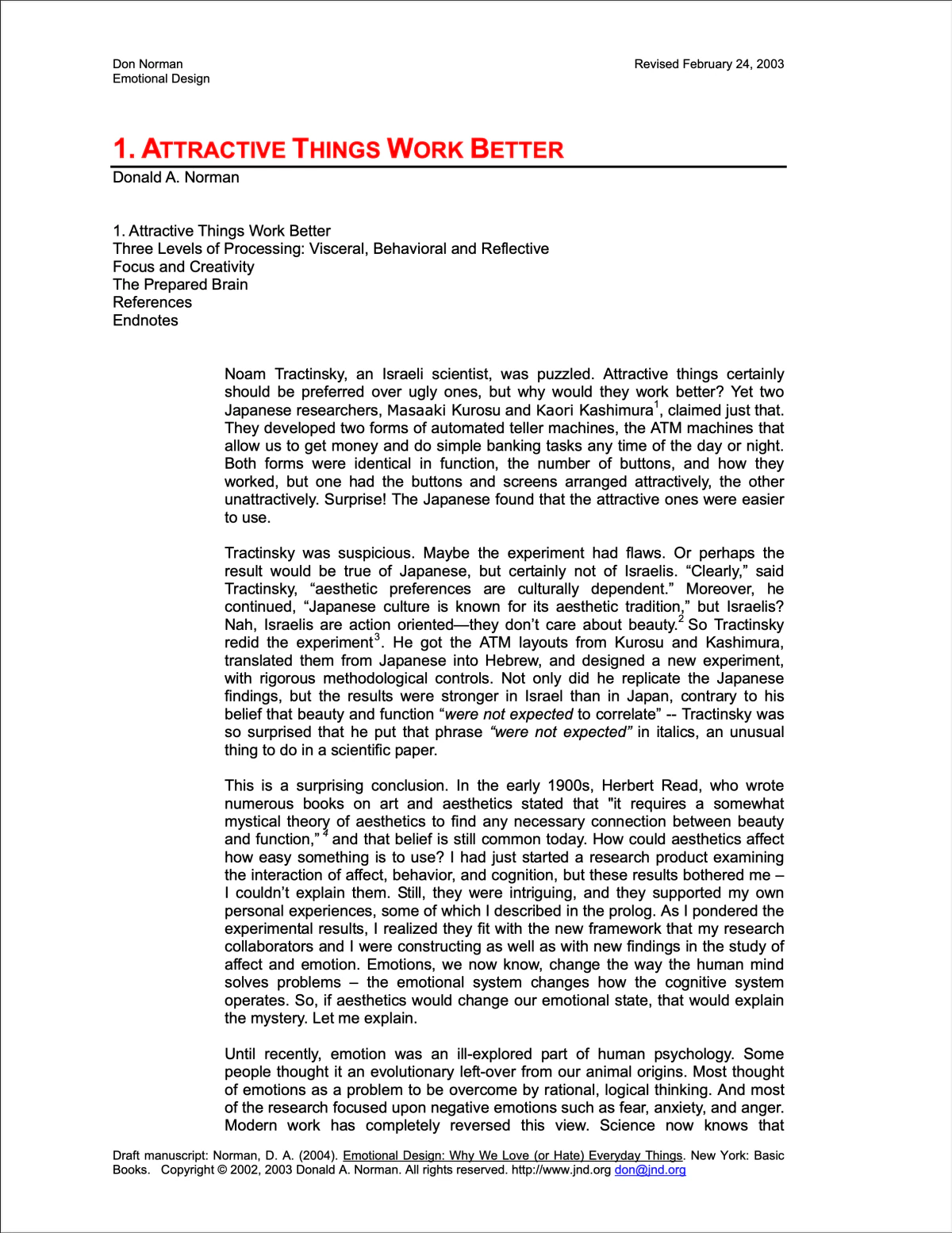
Emotion and Design: Attractive Things Work Better
Donald A. Norman · 01/07/2002
Donald A. Norman's paper presents a compelling argument for the role of emotions in human-computer interaction and design. He posits that objects with emotional appeal are not just more satisfying to use but also function better, a shift from the utilitarian focus in traditional HCI and design.
- Aesthetic-Usability Effects: Norman elucidates the phenomenon where aesthetically pleasing designs appear to function better, hence reinforcing positive user interactions. This challenges the conventional wisdom that form and function are separate dimensions.
- Three Levels of Design: The paper discusses the visceral, behavioral, and reflective levels of design, advocating for an integrated approach that satisfies emotional, functional, and intellectual needs.
- Positive Affect: Norman suggests that positive emotions prime cognitive processes, making problem-solving easier and interactions smoother. This has far-reaching implications for interface design and usability.
- Designing for Emotions: The paper argues for a holistic approach that incorporates emotions into design considerations, rather than treating them as afterthoughts.
Impact and Limitations: The work has been instrumental in reshaping HCI and design fields to include emotional aspects. However, the challenge lies in quantifying emotional experiences and incorporating them systematically into the design process. Further research could refine these aspects, offering more concrete methodologies for achieving emotional resonance in design.
Read more
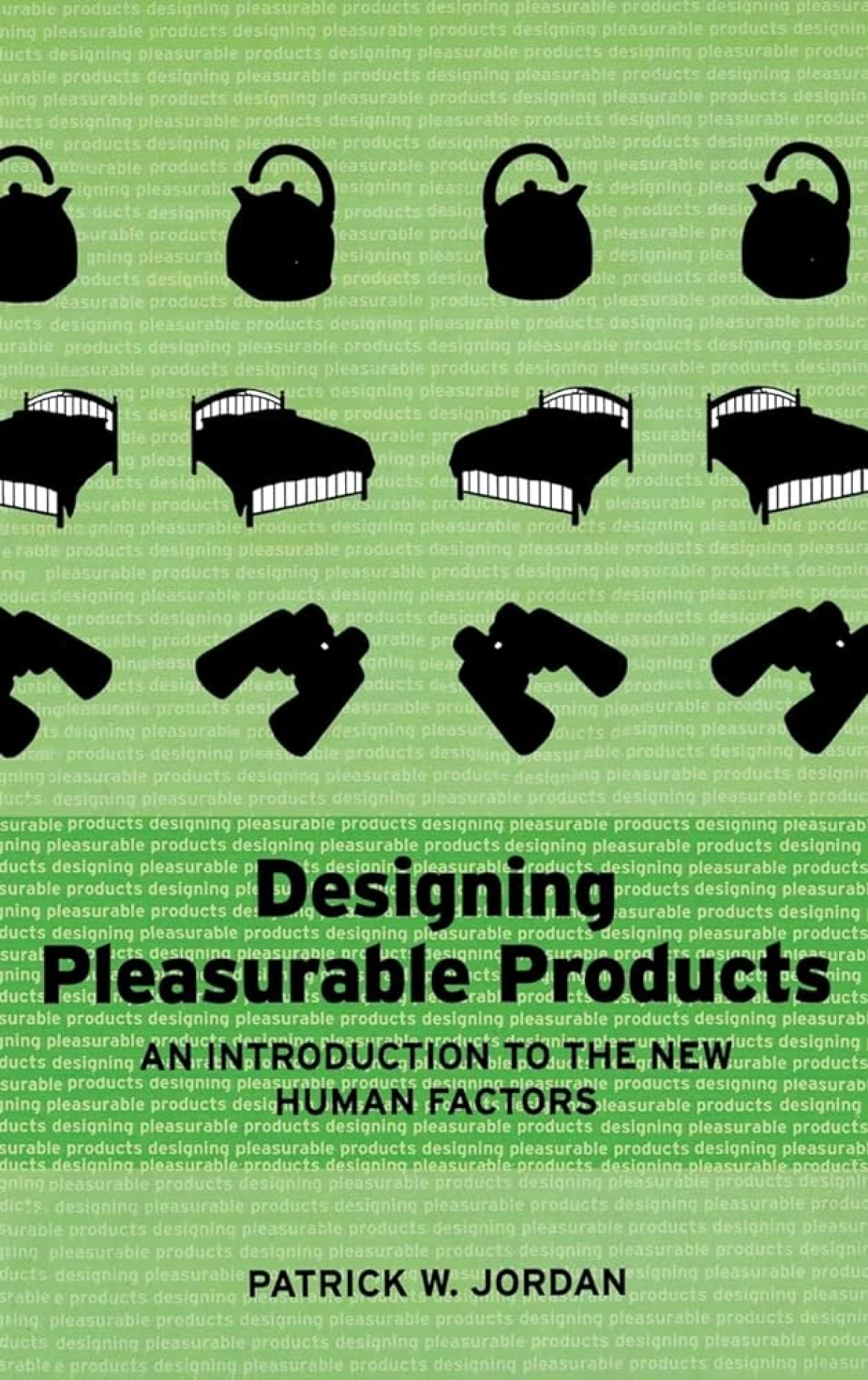
Designing Pleasurable Products: An Introduction to the New Human Factors
Patrick W. Jordan · 01/04/2000
Patrick W. Jordan's seminal book pivots the focus of HCI and design from mere usability to the pursuit of pleasure and emotional engagement in product interaction. This shift has had a long-lasting impact, influencing a generation of designers and researchers to think beyond functionality and efficiency.
- Pleasure Metrics: Jordan introduces frameworks for quantifying pleasure in user experiences. This is revolutionary because it gives practitioners tangible variables to design and test for, beyond typical usability metrics.
- Four Pleasures: The book identifies four categories of pleasure - Physio, Psycho, Socio, and Ideo - and argues for their integration in design. Each type appeals to different human needs and sensory faculties, enabling a more holistic design approach.
- Emotional Branding: Jordan's work has significant implications for emotional branding, suggesting that emotionally resonant products lead to stronger brand loyalty.
- User-Centricity: The book highlights the importance of understanding users' emotional needs and designing products that resonate with those needs, marking a shift from technology-centric to user-centric design.
Impact and Limitations: Jordan's work is groundbreaking and forms the cornerstone for a more humane approach in HCI and product design. However, his frameworks can be difficult to implement systematically, and may lack specificity for different cultural or demographic groups, thus necessitating further refinement and research.
Read more
Where the Action Is: The Foundations of Embodied Interaction
Paul Dourish · 01/10/2001
Paul Dourish's 2001 book revolutionized the field of HCI by introducing the concept of embodied interaction, effectively bridging computer science and social science. It challenges conventional HCI paradigms, urging practitioners to consider not just the digital interface but also the physical and social context in which interaction occurs.
- Embodied Interaction: Dourish's concept of embodied interaction emphasizes the role of the user's physicality in shaping the interaction with the digital environment. This reframing opens up a plethora of design possibilities.
- Social Computing: The book situates HCI within a social context, underscoring the social rules and norms that influence interaction, which was an unconventional idea at the time.
- Tangible Computing: Dourish explores the potential of tangible interfaces that afford physical interaction, influencing subsequent research in areas like tangible bits and interactive tabletops.
- Phenomenology: The book adopts phenomenological theories to explain user behavior, enriching HCI's theoretical base and challenging designers to consider user experience from a different angle.
Impact and Limitations: "Where the Action Is" has had a profound impact on HCI, paving the way for multidisciplinary approaches and tangible computing. However, the book's strong theoretical orientation may make it less accessible for those looking for straightforward, practical guidelines. Future work should aim to translate these theories into actionable insights for designers and engineers.
Read more
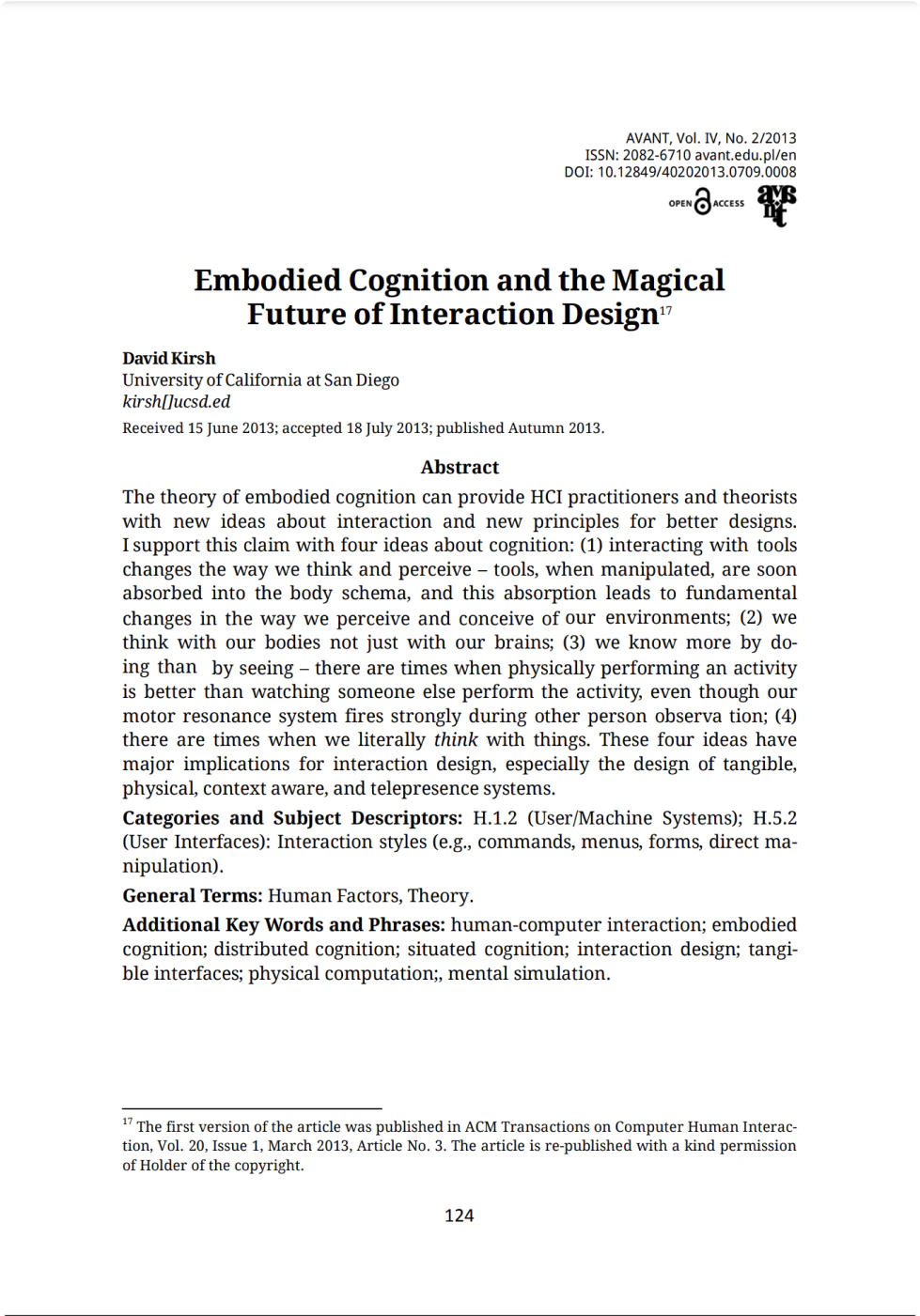
Embodied Cognition and the Magical Future of Interaction Design
David Kirsh · 01/03/2013
This paper delves into the transformative potential of embodied cognition in interaction design, arguing that understanding human cognition as deeply rooted in bodily interactions can pave the way for more intuitive and meaningful human-computer interfaces.
- Embodied Cognition: This approach challenges the "mind-as-computer" model, suggesting that cognition is inseparable from our bodily interactions with the environment. For practitioners, this could mean designing UI elements that are more in sync with natural human movements and thought processes.
- Sensory-Motor Feedback: The paper emphasizes the role of sensory-motor feedback in interaction design. Incorporating haptic, auditory, and visual feedback mechanisms that align with users’ expectations can result in a more fluid and natural UX.
- Adaptive Interfaces: The paper introduces the concept of adaptive interfaces that learn from users' behaviors and physical context, enabling more personalized interactions. This is particularly significant for emerging technologies like AR and VR.
- Context Awareness: It proposes utilizing environmental context, not just user input, to inform design decisions. Practitioners should consider incorporating sensors and AI algorithms to adjust interface elements based on the user's physical context.
Impact and Limitations: The paper's insights have broad implications for HCI, ranging from consumer electronics to assistive technologies. For instance, an adaptive, context-aware interface could significantly enhance the usability of devices for individuals with physical impairments. However, the paper doesn't fully address the ethical implications of such deeply personalized interfaces, like data privacy issues. Future research should explore these ethical considerations and develop solutions that are both innovative and responsible.
Read more
Emotion Recognition from Physiological Signals for Presence Technologies
Choubeila Maaoui, Alain Pruski · 01/09/2010
The 2010 paper by Choubeila Maaoui and Alain Pruski serves as a key milestone in the niche of emotion recognition within the broader HCI landscape. The paper stands out for its emphasis on utilizing physiological signals—such as heart rate and skin conductance—to facilitate emotion recognition in presence technologies.
- Physiological Metrics: The paper expands on how specific physiological metrics can be reliable indicators of emotional states. It paves the way for real-world applications like emotionally responsive gaming or simulation training.
- Presence Technologies: The authors apply their findings to presence technologies, offering novel ways to create immersive, emotionally engaging experiences. This is pivotal for applications like virtual reality and teleconferencing.
- Data Fusion: The paper proposes multi-modal data fusion techniques, allowing for a more nuanced understanding of emotional states by combining multiple biometric markers.
- Real-time Processing: Significantly, the paper discusses the computational methods required for real-time emotion recognition, which has implications for the design of more responsive and intuitive systems.
Impact and Limitations: The paper had a considerable influence on the incorporation of emotion recognition into presence technologies, affecting fields like VR and UX design. However, the work is limited by its primary focus on overt emotional indicators and may not capture the complexity of subdued or mixed emotions.
Read more
Somaesthetic Design
Kristina Höök, Anna Ståhl, Martin Jonsson, Johanna Mercurio, Anna Karlsson, Eva-Carin Banka Johnson · 01/08/2015
This paper, a collaborative effort led by Kristina Höök, pioneers the integration of somaesthetics into interaction design. Emanating from the Mobile Life Centre and associated institutions, it situates somaesthetic design within the broader HCI landscape, establishing it as a groundbreaking framework for creating more holistic, body-centric user experiences.
- Somaesthetics: The framework builds on the philosophical concept of somaesthetics to facilitate more mindful, body-centric interactions. It has been instrumental in guiding designers to pay attention to the rich array of human senses beyond just sight and touch.
- User Embodiment: Höök emphasizes the importance of designing for embodied interaction, where bodily movements and sensations are integral to the user experience.
- Ethical Considerations: Somaesthetic design inherently calls for ethical contemplation, as it often involves deep, personal experiences that need to be handled sensitively.
- Industry Application: With involvement from IKEA, the paper discusses potential large-scale, real-world applications, an essential step for taking the theory into practice.
Impact and Limitations: The paper has carved a unique space in HCI, extending its boundaries to include the often-overlooked aspects of embodied interaction. However, the broad scope and pioneering nature of the work mean that further empirical studies are needed for validation, and the toolkit provided may require fine-tuning for diverse application scenarios.
Read more

Designing Design
Kenya Hara · 01/03/2018
This book explores the principles of design as they apply to human-computer interaction (HCI). The book's major contributions include a renewed focus on the element of simplicity in design and redefining the role of a designer to navigate user experiences.
- Simplicity in Design: The book presents simplicity as a design essential, valuing minimalist interfaces that potentialize ease of use and user experience with HCI systems.
- The Designer as a Navigator: The role of a designer in HCI is likened to that of a navigator, helping users seamlessly interact with technology through well-thought-out design principles.
- Spaces for Interaction: The book stresses the need for creating spaces for interaction that reflect an understanding of user needs, emphasizing user experience and satisfaction.
- Emphasis on White: The idea of emphasizing white or empty space in design is introduced as a way to provide clarity and minimize user strain in HCI.
Impact and Limitations: The principles proposed in this book have the potential to redefine HCI design approaches, focusing on simplicity and user navigation. However, the emphasis on white space might not apply in every context, indicating a need for more research on design customization based on user needs and cultural contexts.
Read more