Speculative & Ethical Perspectives /
What Will the Future of HCI Look Like?
Emerging technologies open up exciting possibilities for how our lives might positively change in the coming decades. Back in the 1990s, pioneering researcher Mark Weiser envisioned a future where technologies would integrate seamlessly into our everyday environments to assist us - what he called "ubiquitous computing." This vision of quiet, helpful computing in the background laid important groundwork for the ecosystems of smart devices we use today. As digital capabilities become more embedded in our surroundings and autonomous, researchers like Steve Mann explore how technology might progressively blend with our identity and sense of self. These radical ideas suggest a shift may be ahead in how closely intertwined humans and computers could become. Envisioning future human-computer relationships requires thoughtfully considering wider social impacts. Responsible innovation frameworks encourage designers to align technological possibilities with social good. Some researchers propose design approaches that embed ethical perspectives into the creative process itself, rather than just evaluating the final output. By speculating on emerging trends like artificial intelligence, augmented reality, and brain-computing interfaces, we get glimpses of how technology might transform lifestyles ahead. Most crucially, this future-gaze mobilizes technology designers to intentionally shape supportive partnerships between people and smart machines still in development. With care and wisdom, we can craft technological advances that enrich our shared humanity.
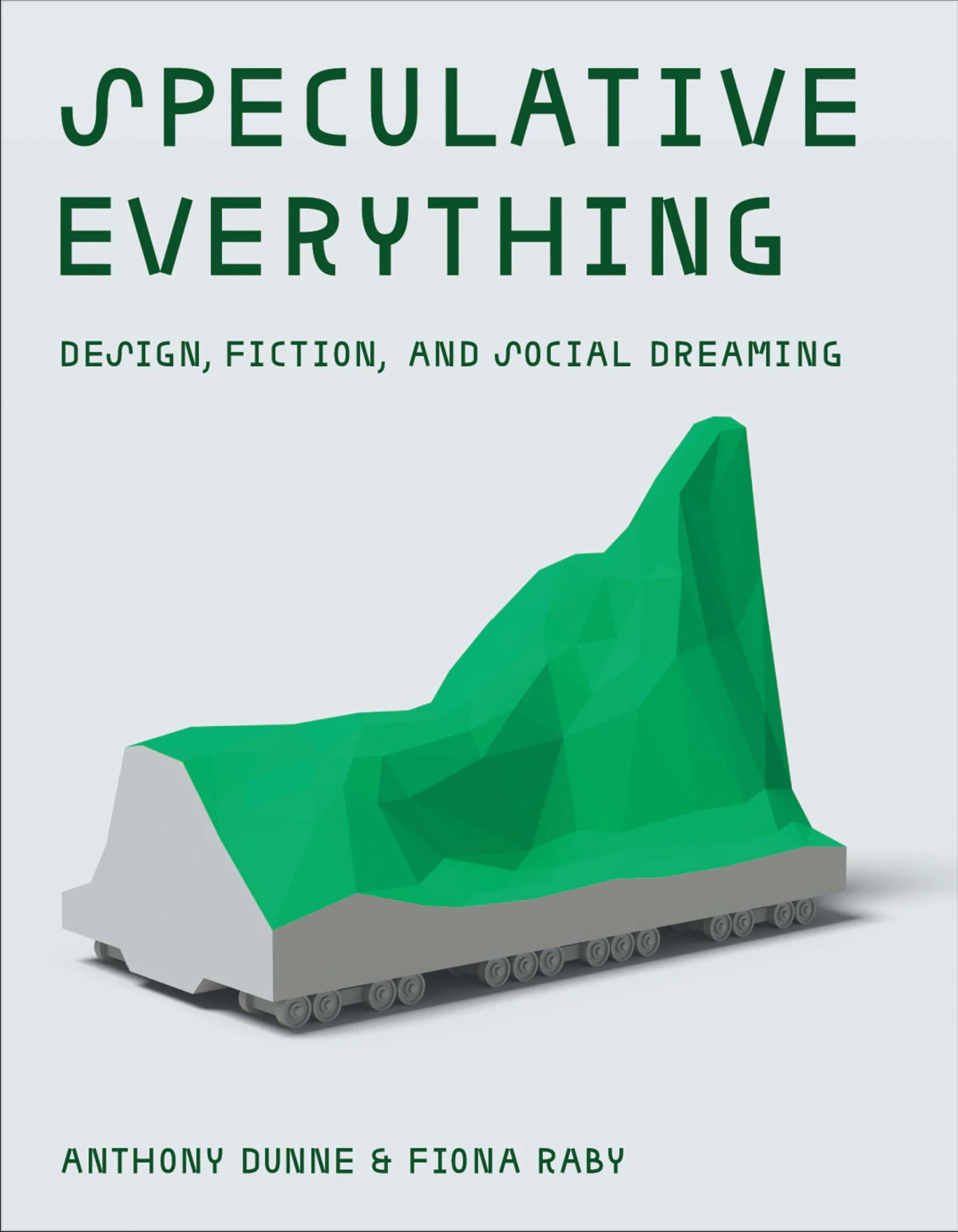
Speculative Everything: Design, Fiction, and Social Dreaming
Anthony Dunne, Fiona Raby · 01/01/2013
"Speculative Everything" challenges the boundaries of conventional design by introducing the concept of speculative design, a discipline that merges design, fiction, and social critique. The book diverges from traditional HCI approaches that focus on problem-solving and efficiency, advocating instead for design as a tool for exploring future scenarios and questioning societal norms.
- Speculative Design: The authors introduce this new paradigm where design is used not just to solve problems but to provoke thought, question the status quo, and imagine alternative realities. It's a shift from utility to possibility in the context of HCI.
- Design Fiction: Dunne and Raby coin this term to describe the practice of crafting narratives around speculative designs, enhancing their impact by situating them within a larger socio-cultural context.
- Ethical and Social Implications: The book emphasizes the role of speculative design in probing the ethical and social implications of technology, suggesting that designers should consider these broader impacts during the ideation phase.
- Participatory Future-casting: It advocates for a more democratic approach to envisioning the future, incorporating multiple perspectives to shape more inclusive technologies and systems.
Impact and Limitations: "Speculative Everything" has reshaped discussions around the purpose and impact of design, extending its influence beyond HCI to ethics, policy, and art. However, the speculative approach may lack immediate applicability, and its effectiveness in driving real-world change remains an open question.
Read more
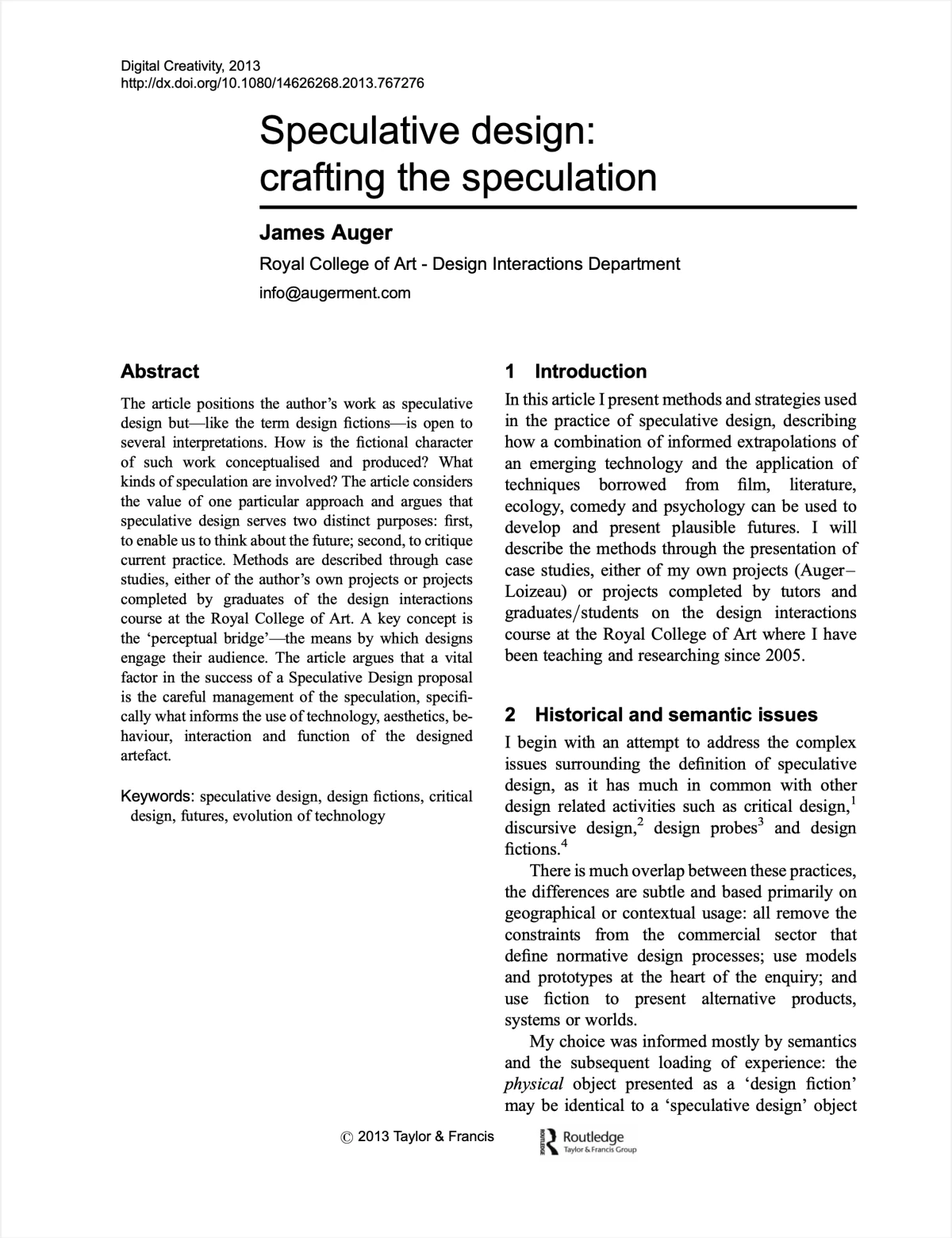
Speculative Design: Crafting the Speculation
James Auger · 01/03/2013
"Speculative Design: Crafting the Speculation" delves into the realm of speculative design, offering a nuanced look at how to navigate the fuzzy borders between fiction and design. It argues that success in speculative design hinges on the meticulous handling of several key aspects.
- Concept of Speculative Design: The paper situates itself within speculative design but recognizes that the term, like 'design fictions,' is amorphous and subject to varied interpretations.
- Two-fold Purpose: According to the author, speculative design serves to facilitate forward-thinking about the future and offer a critical evaluation of present-day practices.
- Case Studies: Methods are illustrated through real-world examples, either drawn from the author's work or from graduates of the Design Interactions course at the Royal College of Art.
- Perceptual Bridge: This concept is integral to how speculative designs captivate their audience. It's the mechanism by which a piece of speculative design establishes its relevance and resonance.
- Crafting the Speculation: A key argument of the paper is that the success of a speculative design proposal is highly dependent on the careful coordination of technology, aesthetics, behavior, interaction, and function.
Impact and Limitations: The paper contributes to the broader dialogue about the role and methods of speculative design. It underscores the need for a fine-tuned approach to speculation, although it leaves open the question of standardizing these methods.
Read more
Design as Future-Making
Susan Yelavich, Barbara Adams · 01/11/2014
"Design as Future-Making," edited by Susan Yelavich and Barbara Adams, is a seminal text that reframes the discipline of design from merely solving present issues to actively shaping the future. It aligns with the broader scope of HCI by encouraging interdisciplinary efforts to imagine and construct futures, thus expanding the possibilities of human-computer interaction.
- Future-Making: This core concept of the book delves into the proactive role of design in shaping societal, technological, and ecological futures, asking not just "What is?" but "What could be?".
- Interdisciplinary Approach: The book highlights the need for merging diverse disciplines—like anthropology, engineering, and HCI—to create holistic solutions for complex problems.
- Ethics and Responsibility: In aiming to shape the future, the text stresses the ethical implications of design decisions, emphasizing designers' responsibility to consider the broader impact of their work.
- Design Methods: New methodologies for future-oriented design are introduced, including scenario planning and speculative design, that go beyond traditional HCI techniques.
Impact and Limitations: "Design as Future-Making" has far-reaching implications for HCI, as it shifts the focus towards proactive and ethical design, challenging the field to be more future-oriented. However, the book could be criticized for lacking a comprehensive framework to implement its ambitious vision, thus requiring further research and practical applications to validate its claims.
Read more
The Manual of Design Fiction
Julian Bleecker, Nick Foster, Fabien Girardin, Nicolas Nova, Near Future Laboratory, Chris Frey, Patrick Pittman · 01/01/2022
"The Manual of Design Fiction" by Julian Bleecker et al. is a 2022 work that serves as a comprehensive guide to the field of Design Fiction. Though not strictly in the HCI domain, it has crucial implications for those interested in speculating about future technologies and user interactions. The manual situates itself within the intersection of design, storytelling, and future-casting.
- Design Fiction: This refers to the practice of creating speculative, fictional scenarios as a means to explore and critique possible futures. It serves as a powerful tool for HCI designers to consider multiple possibilities and ethical implications.
- Prototyping Futures: The manual suggests that design fiction can act as a kind of 'conceptual prototyping,' allowing designers to explore the social, cultural, and ethical dimensions of potential technologies before they are made real.
- Storytelling in Design: Storytelling is highlighted as an essential skill in design fiction. Narratives serve to contextualize technologies, making them relatable and understandable, which is beneficial for user experience and interaction design.
- Methodology: It offers practical approaches and methodologies for implementing design fiction, from scenario creation to representation methods like storyboards or videos.
Impact and Limitations: The book offers a novel way to think about design, especially in the context of emerging technologies and ethical implications. However, the application of design fiction can be time-consuming and may not offer immediate, pragmatic solutions, pointing towards a need for further work on how to integrate this effectively into traditional HCI methods.
Read more