Collaborative & Social Computing /
What Role Do Social Dynamics Play in Collaborative Computing?
The relationship between social behaviors and collaborative technology represents an intricate balancing act at the core of computer-supported cooperative work (CSCW). Since CSCW's beginnings in the 1980s, led by pioneers like Irene Grief and Paul Cashman, the field has diligently worked to unite technical systems with the complexity of human social connections. Early CSCW interfaces prominently focused on enhancing tasks, but soon found that elements like social awareness, communication richness, and group dynamics pivotally shape outcomes. Improving workspace awareness through audio/video and synchronous editing dramatically boosted collaboration. And because people innately treat computers socially, misaligned system feedback frustrates users. Today, CSCW continues navigating technical and social considerations through innovations like conversational interfaces, augmented workspaces, and VR collaboration platforms. But effective development still relies profoundly on accommodating the intricacies of interpersonal group processes. By designing interfaces transferring social signals, creativity flourishes. This ongoing socio-technical balancing act remains vital for unlocking technology's full potential to augment collective human capabilities.
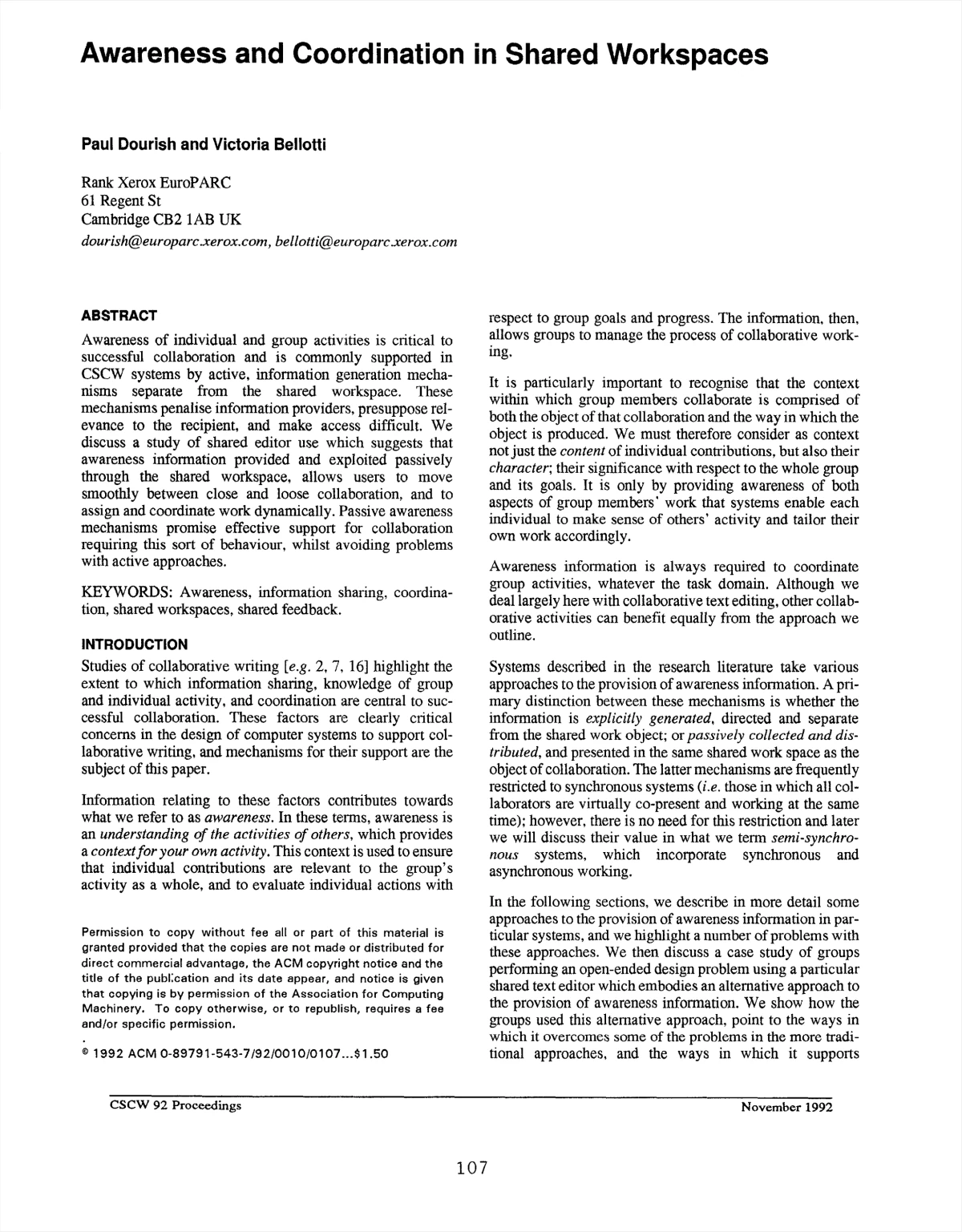
Awareness and Coordination in Shared Workspaces
Paul Dourish, Victoria Bellotti · 01/11/1992
This paper explores the concept of awareness in collaborative workspaces, asserting shared understanding and co-ordination among teams as crucial elements for successful collaboration. It offers foundational groundwork in the field of HCI on Computer-Supported Cooperative Work (CSCW).
- Awareness in CSCW: The authors define awareness as an understanding of the activities of others, critical for the smooth progression of the joint task. It comprises an understanding of the individual and collective activities that shape the shared workspace.
- Informal Communication: Informal, unplanned communications play a significant role in building awareness among teams. Digital tools can be enhanced to facilitate these non-verbal and spontaneous interactions.
- Articulation Work: This refers to the coordination and integration tasks that give structure to the larger activity, incorporating the interactions and practices beyond the individual workplace actions.
- Embedding Awareness: Emphasizing on the need to embed awareness in system design, the authors suggest a shift from viewing awareness as a communication problem to one of social interaction.
Impact and Limitations: The paper’s insights have significant implications for the development of collaborative tools promoting social interactions, and in shaping HCI's understanding of CSCW. However, technology's role in facilitating non-verbal communication remains a challenge. Future studies should explore more practical approaches to implement systems that foster awareness and enhance collaboration.
Read more
Groupware and Social Dynamics: Eight Challenges for Developers
Jonathan Grudin · 01/01/1994
This HCI paper elucidates eight key challenges faced by developers in creating groupware. Grudin outlines the factors contributing to the lag in wide adoption of groupware, despite its potential for enhancing collaboration in the workplace.
- Disparity in work and benefit: The paper discusses how groupware often entails extra work for some while others reap the benefits, leading to low utilization.
- Critical Mass and Prisoner's Dilemma: Grudin explains how effective use of groupware requires a critical mass of users, creating a paradox where its value is only visible when widely used.
- Unobtrusive Accessibility: The author postulates that groupware should be seamlessly integrated and unobtrusive in a way that it becomes a natural extension of users' work habits.
- Evaluation Difficulty: The paper highlights that traditional methods of software evaluation may not be applicable to groupware due to its unique dynamics.
Impact and Limitations: Grudin’s work is a valuable resource for HCI practitioners and groupware developers, shedding light on often overlooked social dynamics in groupware utilization. The findings, however, are mainly based on the 1990s groupware context and may not fully apply to today’s ubiquitously connected work environments. Future research could focus on modern-day challenges in groupware development.
Read more
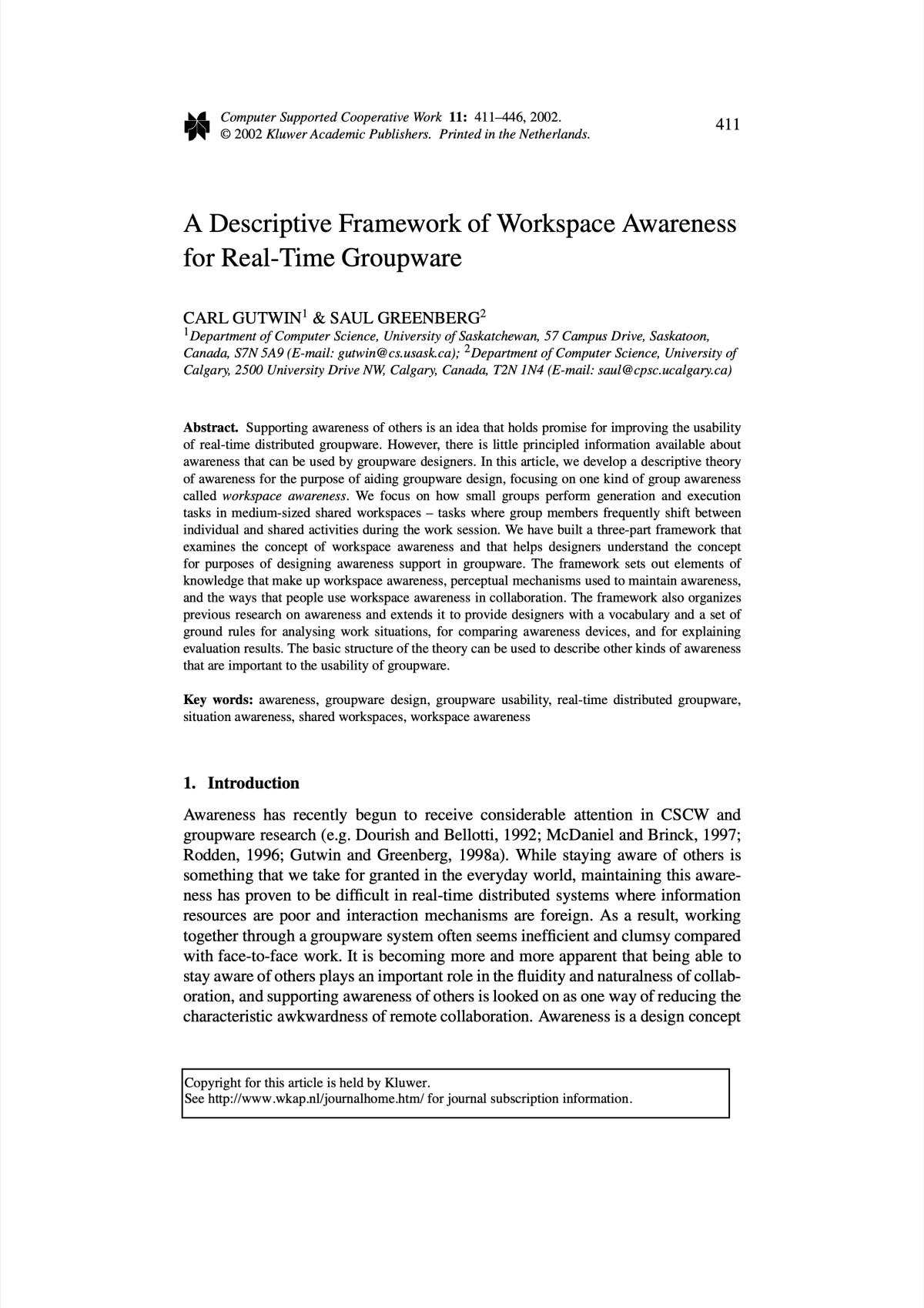
A Descriptive Framework of Workspace Awareness for Real-Time Groupware
Carl Gutwin, Saul Greenberg · 01/11/2002
This paper presents an innovative framework to comprehend workspace awareness in real-time groupware. Gutwin and Greenberg's work sits at the crux of HCI, redefining the foundations of asynchronous collaboration in computer-supported work.
- Workspace Awareness: The authors present workspace awareness as a critical element for effective group work. It refers to up-to-the-minute understanding of others' activities, intentions, and needs in a shared workspace.
- Descriptive Framework: Their framework unwraps the layered concept of workspace awareness, delineating it into components like who, what, where, and when. This decomposition allows more nuanced analysis and design of groupware systems.
- Mechanisms of Maintaining Awareness: The paper identifies channels like verbal communication, passive listening, and direct and indirect visual contact as mechanisms for maintaining workspace awareness.
- Interface Design Suggestions: Practical suggestions are offered for interface design, like the integration of overview and detail views, to enhance workspace awareness.
Impact and Limitations: The introduced framework revolutionizes the design and implementation of groupware systems, enhancing overall team productivity. However, the universality of the proposed framework across various real-time geographically dispersed groups needs thorough exploration. More research could be directed towards quantifying the real impact of workspace awareness on collaborative activities.
Read more
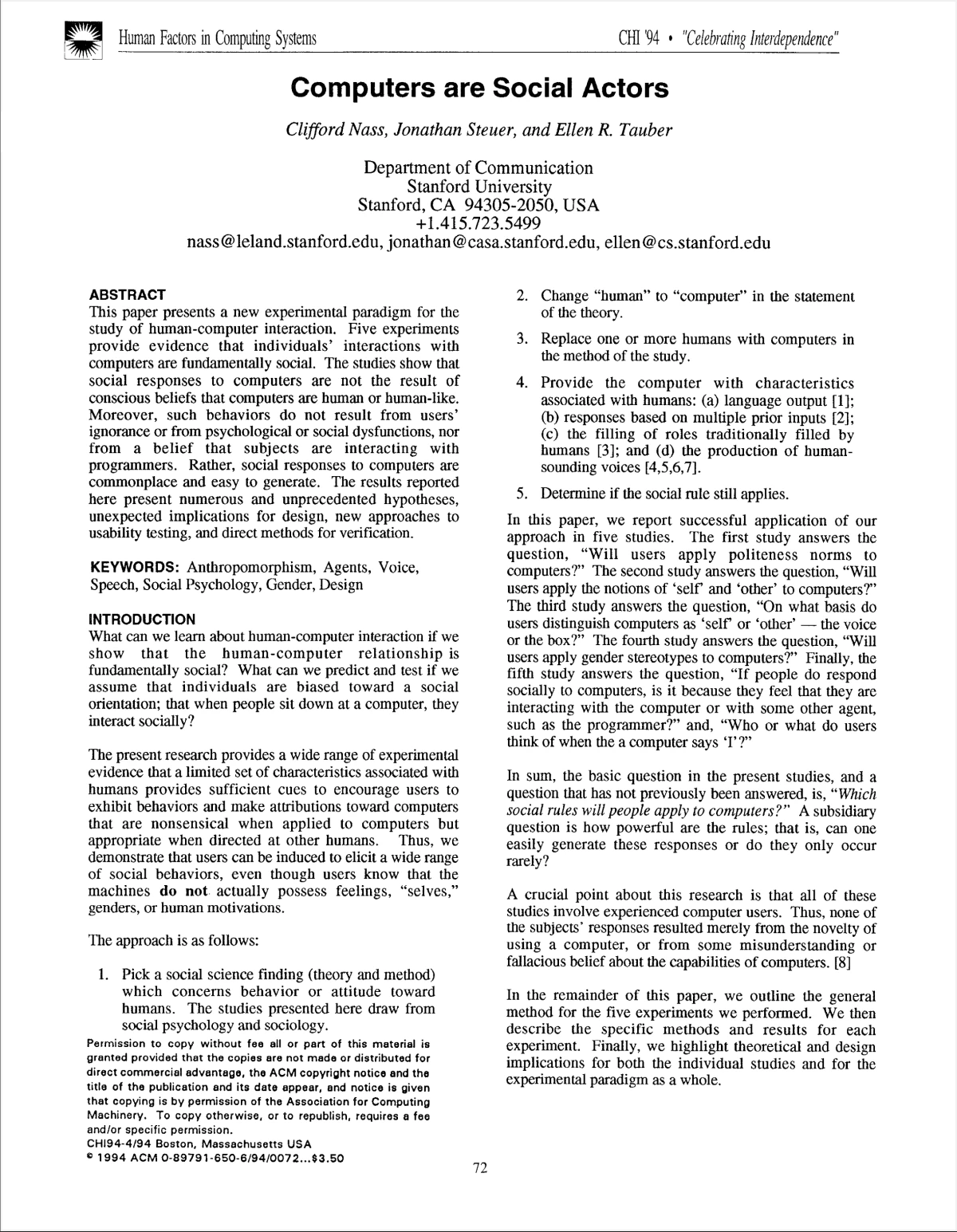
Computers are Social Actors
Clifford Nass, Jonathan Steuer, Ellen R. Tauber · 01/04/1994
This 1994 paper by Nass, Steuer, and Tauber stands as a watershed moment in human-computer interaction (HCI), pushing the boundary of how we perceive interactions with computers. The authors assert that users unconsciously treat computers as social actors, thereby introducing the idea that human-social rules might apply to human-computer interaction.
- Anthropomorphism in HCI: The paper presents experiments showing that people apply social rules and norms, like politeness, even when interacting with computers. This challenges the notion that human-computer interaction is fundamentally different from human-human interaction.
- Social Dynamics: Beyond simple tasks, users attribute personality and even gender to machines. This insight can be used to inform more engaging and intuitive interface designs, making them relatable to users.
- Para-Social Interactions: The concept here is that interactions with computers can evoke emotional responses, similar to interactions with humans. This complicates the interface design process, but also opens doors for more immersive experiences.
- Ethical Implications: If computers are treated as social actors, then ethical considerations, such as honesty and accountability, come into play, particularly in AI-driven interfaces.
Impact and Limitations: This paper significantly influenced subsequent HCI and AI research, driving more sophisticated, socially-aware systems. However, the risks of anthropomorphizing machines—such as overtrust or emotional dependence—remain an area for further study and ethical deliberation.
Read more
ReGroup: Interactive Machine Learning for On-Demand Group Creation in Social Networks
Saleema Amershi, James Fogarty, Daniel S. Weld · 01/05/2012
The paper introduces 'Regroup,' an innovative interactive machine learning (IML) system for on-demand group creation in social networks. This highlight of HCI research profoundly improved user experiences with grouping functionality.
- Interactive Machine Learning: The paper discusses IML and its application in developing user-centric grouping functions in social networks, providing a unique approach to personalization and information organization.
- Multifaceted Group Creation: Regroup supports on-the-fly group creation based on diverse user requirements, enhancing users' control over their social media experience.
- User Evaluation: Through rigorous user studies, the authors demonstrate that 'Regroup' facilitates enhanced user performance and satisfaction when managing social group creation.
- Guidance and Explanation: The mechanism offers transparent operation and explains system outputs, thereby nurturing trust and improved user interaction with the IML.
Impact and Limitations: The paper's findings hold substantial implications for HCI and technology, paving the way for personalized, user-centric designs in social media platforms, and potentially other domains. It underlines the significance of IML in enhancing user experience through customization. Limitations include the need for more extended usability studies with diverse user groups and more extensive exploration of trust-building mechanisms in IML systems. Further research could help optimize this approach to group creation.
Read more