Interaction /
Is Context-Awareness the Key to Seamless Technology Integration?
The vision of context-aware computing promises technology that silently anticipates our needs without explicit direction. This idea of systems that understand situational context to adapt accordingly has driving increasing pursuit of seamless human-computer integration. Early pioneers like Mark Weiser foresaw context as critical for calm computing experiences that empower without obstructing. Researchers followed exploring context-sensitive concepts for decades, examining sensing capabilities and modeling techniques to unlock responsive environmental interfaces. The proliferation of mobile devices and IoT ecosystems have brought context-awareness closer to widespread viability. Machine learning now enables devices to interpret situational signals like location, time, activity, or social setting to predict relevance and needs on-the-fly. Contextually intelligent systems aim to grasp human intention and bridge the gaps separating digital and physical worlds. Today HCI leverages context-awareness in emerging interaction modalities like conversational interfaces, predictive notifications, specialized wearables, and spatial computing. By imbuing systems with perceptual skills to see context from a human perspective, the next era of calm, assistive computing hopes to fade technology into the fabric of living.
The Home Information Terminal
John McCarthy · 01/01/1970
John McCarthy's 1970 work, "The Home Information Terminal," presents an astonishingly prescient vision of the future, envisioning home computing at a time when computers were predominantly seen as large, corporate machines. The paper situates itself at the origins of HCI, positing a future where computers become integral to daily life.
- Ubiquitous Computing: McCarthy's concept strongly suggests a future of ubiquitous computing, well before it became a buzzword. His ideas underscore the need for designers to consider the human factors in any computing environment.
- User-Centric Design: The paper advocates for systems tailored to meet individual needs, stressing the importance of customization and adaptability in user interfaces.
- Networking: McCarthy envisions a connected world, highlighting the impending significance of the Internet and online communication, which would become fundamental aspects of HCI.
- Natural Language Processing (NLP): McCarthy postulates the use of natural language for interaction, an idea that has since led to advances in chatbots and voice-activated systems.
Impact and Limitations: McCarthy's paper was groundbreaking, laying the conceptual groundwork for smart homes, IoT, and even aspects of ambient computing. However, it was largely speculative and did not provide practical implementation details, indicating a gap for future research and development.
Read more
The Computer for the 21st Century
Mark Weiser · 01/09/1991
Mark Weiser's "The Computer for the 21st Century" is a cornerstone paper in the field of Human-Computer Interaction (HCI). This seminal work introduced the concept of ubiquitous computing, envisioning a future where computing is seamlessly integrated into our daily lives, thus fundamentally changing our interaction with technology.
- Ubiquitous Computing: Weiser's groundbreaking idea proposed that computing would transition from desktops to an integrated part of the environment. For HCI practitioners, this led to a paradigm shift towards designing for pervasive, context-aware systems.
- Calm Technology: Weiser introduced the idea that technology should recede into the background, supporting human activities without demanding constant attention. This has far-reaching implications for designing unobtrusive user interfaces and experiences.
- Human-Centric Design: The paper emphasized the need for technology to adapt to human needs rather than the other way around. This has become a guiding principle in HCI, underscoring the importance of user-centered design methodologies.
- Sensors and Smart Environments: Weiser’s vision included the use of environmental sensors to create smart spaces. This foresight has relevance for HCI in the era of IoT, where interaction is not just screen-based but involves a network of interconnected devices.
Impact and Limitations: "The Computer for the 21st Century" has had a profound impact, setting the research agenda for ubiquitous computing and influencing the design of consumer electronics, smart homes, and IoT devices. However, Weiser's vision is yet to be fully realized, particularly in terms of interoperability and data privacy concerns, warranting further research and development in these areas.
Read more
Contextual Design: Defining Customer-Centered Systems
Hugh Beyer, Karen Holtzblatt · 01/09/1997
The book by Beyer and Holtzblatt serves as a seminal contribution to HCI by introducing the Contextual Design framework. Building upon user-centered design principles, this work delves into the complexities of understanding users in their natural environments and the implications for designing more effective systems.
- Contextual Inquiry: The authors highlight the importance of observing and interviewing users in their natural context, providing insights that cannot be gained through traditional usability testing alone.
- Work Models: The book introduces a set of models to represent the workflow, cultural and physical environment, and the users themselves. This structured representation helps designers to understand and act on complex user needs and scenarios.
- Iterative Design: Contextual Design emphasizes the importance of ongoing, iterative cycles of prototyping and feedback, adapting the design to real-world use cases and continuously aligning it with user needs.
- Customer-Centered Focus: Unlike other approaches that may be technology- or business-centric, Contextual Design insists on a customer-centered paradigm, taking a more holistic approach to design.
Impact and Limitations: This methodology has had a lasting impact on HCI and UX design, leading to a more nuanced, deeply contextual understanding of user needs. However, the approach demands substantial time and resource investment, which may be a limitation for projects with tighter constraints.
Read more
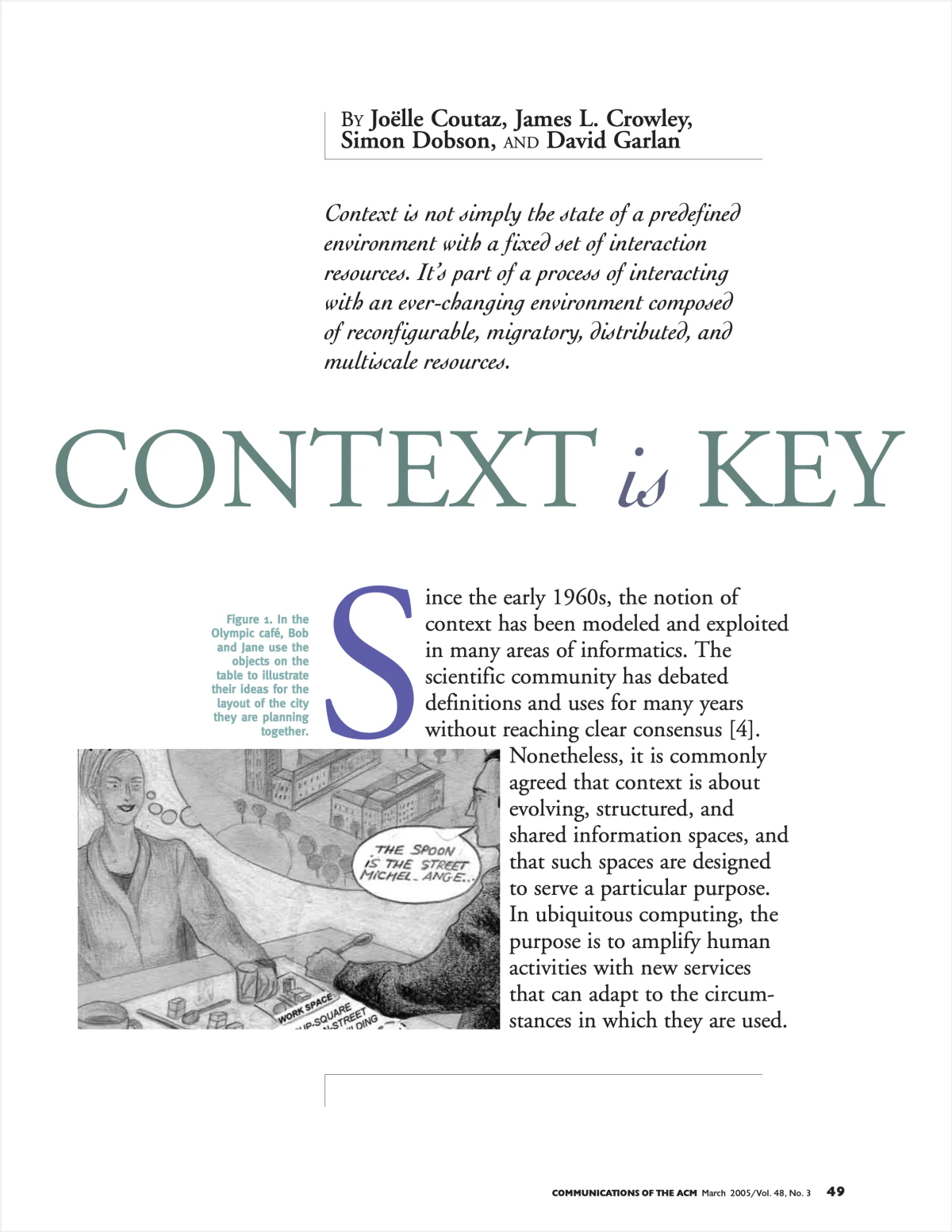
Context is Key
Joëlle Coutaz, James L. Crowley, Simon Dobson, David Garlan · 01/03/2005
The 2005 paper "Context is Key" by Coutaz et al. stands as a cornerstone in Human-Computer Interaction (HCI) and ubiquitous computing. The paper articulates the multi-dimensional nature of context and emphasizes its pivotal role in shaping adaptive, intelligent systems.
- Context-awareness: The authors go beyond location and time to introduce a comprehensive framework for context, involving user activity, environmental conditions, and even future predictions, offering a new avenue for context-sensitive applications.
- Middleware Design: It also explores how context can be incorporated into middleware design, thereby influencing the behavior of distributed systems in real-time.
- Semantic Richness: The paper proposes methods for creating context models that capture a rich semantic understanding, thereby enhancing system adaptivity and responsiveness.
- Dynamic Adaptation: Contextual information is leveraged to facilitate dynamic adaptation, enabling systems to predict and react to user needs in a fluid manner.
Impact and Limitations: This paper has significantly impacted the design of intelligent, adaptive systems. It provides a theoretical framework that has been used to develop practical context-aware applications. However, the complexity of truly capturing and leveraging multi-dimensional context remains a challenge, warranting further exploration and research.
Read more